


Trivita AI is proud to announce that the research work “Shape-Adapting Gated Experts (SAGE)” has been officially accepted at CVPR Findings 2026, one of the world’s leading conferences in Artificial Intelligence and Computer Vision.
Having a paper recognized at CVPR 2026 marks not only a significant research milestone, but also reinforces Trivita AI’s strategic direction: building AI systems grounded in solid theoretical foundations while delivering strong execution capability in complex healthcare environments.
Shape-Adapting Gated Experts: Dynamic expert routing for colonoscopic lesion segmentation
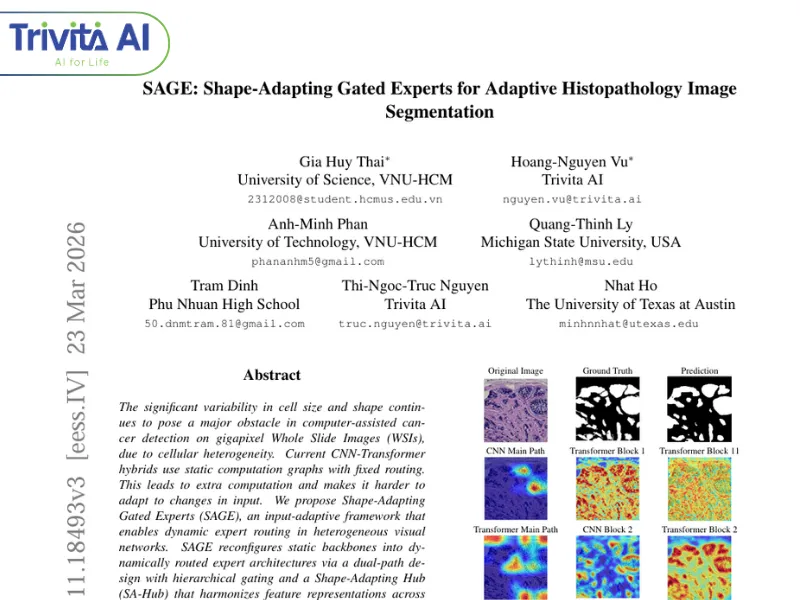
Histopathology image segmentation remains a fundamentally challenging problem due to cellular heterogeneity, where tissue structures vary significantly in shape, size and morphology. This challenge is further amplified in Whole Slide Images (WSIs), which are gigapixel-scale and require both high accuracy and computational efficiency.
To address this, we propose Shape-Adapting Gated Experts (SAGE), a novel framework that introduces dynamic expert routing into hybrid CNN–Transformer architectures, enabling adaptive computation based on input complexity.
Core Technical Contributions
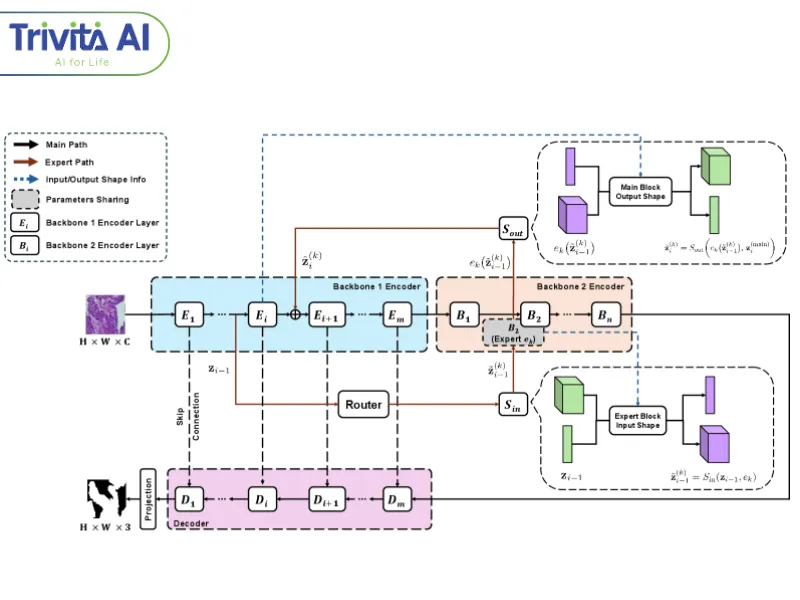
At its core, SAGE transforms static computation into an adaptive system through a dual-path architecture. The main path maintains stable representations, while the expert path selectively activates specialized blocks depending on the input.
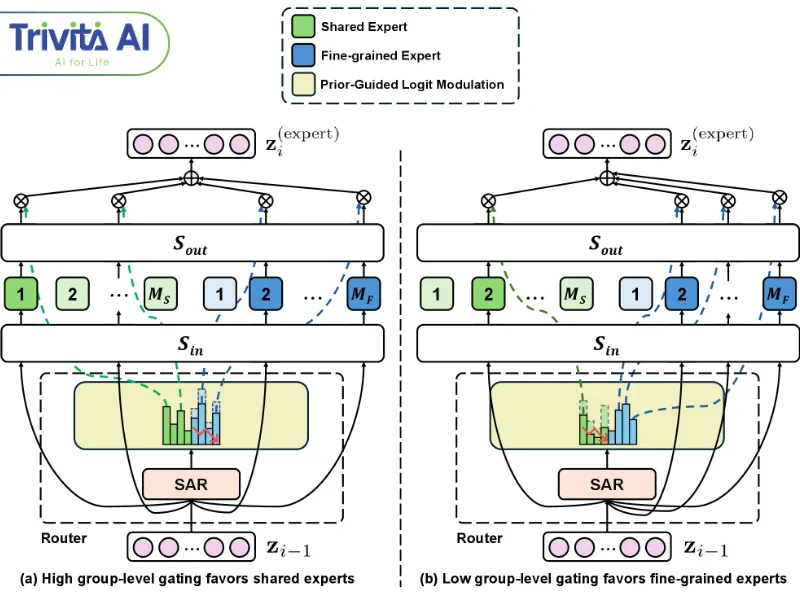
This is further enhanced by a hierarchical routing mechanism, where the model first determines whether to use shared or specialized experts, and then selects the most relevant experts via a Top-K strategy. This design aligns with the Mixture of Experts (MoE) paradigm, enabling scalability without proportional computational cost.
A key innovation is the Shape-Adapting Hub (SA-Hub), which bridges the gap between CNN and Transformer representations by enabling bidirectional transformation between 2D feature maps and 1D token sequences. This allows the model to leverage both local spatial features and global contextual reasoning.
Additionally, SAGE employs independent sigmoid gating, allowing multiple experts to collaborate rather than compete, which is particularly important for handling ambiguous or overlapping patterns in medical data.
Technology value
SAGE introduces a new paradigm for building adaptive and efficient AI systems:
- Input-adaptive computation: Instead of applying uniform processing, the model dynamically adjusts its computational pathway based on input complexity
- Scalable model capacity: Through dynamic routing and MoE principles, SAGE increases model expressiveness without increasing computational cost proportionally
- Cross-architecture integration: SA-Hub enables seamless interaction between CNN and Transformer, overcoming a key limitation in hybrid models
- Efficient resource utilization: Sparse activation ensures that only relevant parts of the model are engaged, significantly reducing unnecessary computation
- Improved interpretability: Built-in support for Grad-CAM enables transparent decision-making
These technological advances position SAGE as a strong foundation for next-generation AI systems that must operate under real-world constraints.
Real-world applications
SAGE is designed with deployment in mind and demonstrates strong performance in practical settings:
Automated cancer diagnosis on WSIs
SAGE processes gigapixel Whole Slide Images, enabling automated detection of malignant tissues.
- Achieves 95.23% Dice score on EBHI dataset
- Particularly effective for colorectal cancer diagnosis
Adaptive medical image processing
The model dynamically identifies complex regions and allocates more expert capacity where needed, while reducing computation in simpler regions. Improves efficiency without compromising accuracy
Clinical decision support systems (CDSS)
Through Grad-CAM heatmaps, SAGE provides visual explanations of its predictions, helping clinicians understand model reasoning and increasing trust in AI-assisted diagnosis
Deployment in resource-constrained environments
Thanks to sparse activation, SAGE significantly reduces computational overhead, making it suitable for:
- Hospitals with limited hardware
- Large-scale pathology systems
- Real-world clinical workflows
Strategic impact for Trivita AI
SAGE represents a critical step in Trivita AI’s transition toward adaptive AI systems that can operate reliably in heterogeneous, real-world environments.
Rather than relying on fixed computation pipelines, SAGE enables systems that adjust dynamically to data characteristics, which is essential for domains like healthcare where variability is the norm.
Moreover, the combination of scalability, efficiency and interpretability allows Trivita AI to develop AI solutions that are not only high-performing but also deployable at scale. This reinforces our positioning as a company focused on execution, deployment and real-world impact, not just theoretical advancement.
The acceptance of SAGE at CVPR Findings represents more than a research milestone, it reflects a broader direction in how AI systems should be designed and deployed in real-world environments.
By introducing dynamic expert routing, adaptive computation and efficient resource utilization, SAGE addresses a fundamental gap between high-performing models in controlled settings and the practical requirements of large-scale, real-world systems. Its ability to balance accuracy, efficiency and interpretability makes it particularly well-suited for high-stakes domains such as healthcare.
For Trivita AI, this work reinforces a clear strategic direction: building AI systems that are not only scientifically advanced, but also operationally viable. Rather than pursuing research in isolation, Trivita AI focuses on developing technologies that can be directly translated into deployable solutions, capable of creating measurable impact in real environments.
