

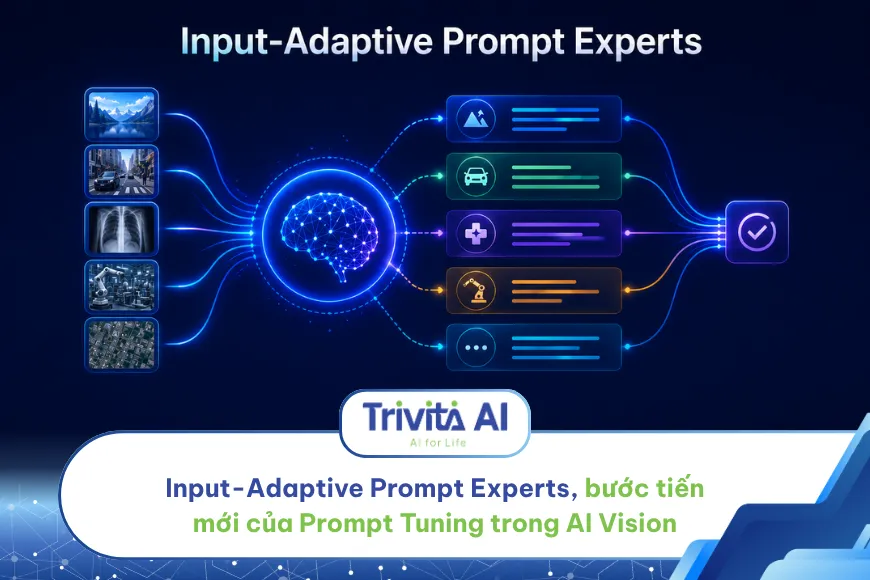
Input-adaptive prompt experts are adaptive prompt mechanisms used in VAPT, enabling AI Vision systems to improve accuracy and efficiency under low-data conditions.
What are Input-Adaptive Prompt Experts?
Input-adaptive prompt experts are the core component of Visual Adaptive Prompt Tuning (VAPT), developed to address the limitations of static prompts in traditional Visual Prompt Tuning (VPT).
In VPT, prompts are typically fixed vectors appended to the model input and remain identical for all images. This limits the adaptability of the system when input data varies significantly.
Input-adaptive prompt experts fundamentally change this approach. Instead of using static prompts, the system dynamically generates prompts conditioned on the characteristics of each individual image. As a result, prompts become adaptive to input data rather than operating independently from the input as in previous methods.
This shift transforms prompts from static vectors into data-adaptive mechanisms within modern AI Vision systems.
Why do static prompts in traditional VPT become a limitation?
Prompts do not change according to data
In traditional Visual Prompt Tuning, prompts are designed as fixed vectors that remain unchanged regardless of differences in input images.
This means the same prompt set is used across all data types, regardless of variations in image structure, context or visual characteristics.
Meanwhile, Transformer attention components dynamically respond to input data, whereas prompts in VPT remain static. This creates a major imbalance in the representational mechanism of the model.
Limited representational capability
Because prompts remain invariant to input data, the representational capability of the system becomes significantly constrained when processing diverse datasets.
This issue becomes especially evident in low-data scenarios or complex downstream tasks. Static prompts often struggle to learn the flexible visual representations necessary to adapt to different situations.
This limitation is one of the primary reasons why Visual Adaptive Prompt Tuning was introduced, transforming prompts into genuinely adaptive components conditioned on input data.

How do Input-Adaptive Prompt Experts work in VAPT?
Prompts are conditioned on input data
In VAPT, prompt tokens are no longer directly learned as fixed vectors like in VPT. Instead, prompts are dynamically generated based on the features of the input image.
This allows the system to create different prompts for different samples. Prompts therefore become functions of the input rather than independent static representations.
This approach enables the model to respond more flexibly to variations in image characteristics.
Using token-wise projectors and feature projectors
To generate adaptive prompts, VAPT uses components such as token-wise projectors and feature projectors to extract global information from the input image.
This information is then used to generate prompts tailored to the specific data sample. As a result, prompts contain richer and more relevant visual representations instead of functioning merely as static learned vectors.
This is one of the key technical differences that gives VAPT stronger representational power compared to traditional VPT.
Integration with Transformer attention
Input-adaptive prompt experts do not operate independently from the model backbone. These prompts directly interact with the pretrained experts embedded inside Transformer attention heads.
This enables the system to more effectively leverage the pretrained knowledge contained within foundational vision models and adapt more efficiently to downstream tasks.
The interaction between adaptive prompt experts and attention mechanisms allows VAPT to maintain high performance without requiring full model fine-tuning.
Why do Input-Adaptive Prompt Experts have stronger representational capability?
The most important distinction of input-adaptive prompt experts is that prompts are no longer fixed vectors, but instead become functions conditioned on input data.
This significantly improves functional expressiveness, meaning the representational capability of the model. Prompts can now dynamically respond to the unique characteristics of each image instead of applying identical representations across all data samples.
This adaptability enables the model to learn more complex representations, handle highly diverse data more effectively and maintain strong performance even under limited-data conditions.
This is also why VAPT consistently outperforms traditional prompt tuning approaches.
Advantages of Input-Adaptive Prompt Experts
Improved sample efficiency
One major advantage of input-adaptive prompt experts is their effectiveness under low-data conditions.
Because prompts adapt according to input features, the model learns faster and utilizes data more efficiently compared to static prompts.
This is particularly important in practical AI Vision tasks where labeled data is often expensive or difficult to obtain.
Significant performance improvement
Research results demonstrate that VAPT achieves strong performance across benchmarks such as VTAB-1K and FGVC.
The ability to adapt prompts based on input data substantially improves accuracy compared to traditional prompt tuning approaches, especially for complex downstream tasks.
Maintaining parameter efficiency
Despite significantly increasing representational capability, input-adaptive prompt experts still preserve the key advantage of PEFT (Parameter-Efficient Fine-Tuning), namely high parameter efficiency.
The system does not require fine-tuning the entire backbone and instead updates only a very small subset of parameters. This substantially reduces GPU cost, memory usage and training time.
This is an important factor for practical AI Vision deployment.
Strongly outperforming static prompts in VPT
The difference between adaptive prompts and static prompts becomes especially apparent under low-data conditions.
For example, on the Stanford Dogs dataset using only 1% of training data, VAPT achieves approximately 60.1% accuracy, whereas VPT achieves only around 3.6%.
This substantial gap demonstrates that input-adaptive mechanisms enable models to learn much more effectively when training data is limited.

The significance of Input-Adaptive Prompt Experts for modern AI Vision
The emergence of input-adaptive prompt experts demonstrates that prompt tuning is no longer simply about inserting fixed tokens into models.
The current trend in AI Vision is moving toward building prompts that dynamically adapt to input data in order to better leverage foundational vision models.
This makes AI Vision systems more flexible, more powerful and more suitable for practical deployment scenarios involving highly diverse data.
Input-adaptive prompt experts are increasingly considered an important direction for PEFT in modern AI Vision research.
Input-Adaptive Prompt Experts help advance VPT
Input-adaptive prompt experts represent an important advancement in the evolution of Visual Prompt Tuning.
The focus of prompt tuning is shifting from static prompts toward input-adaptive prompts. This transformation improves representational capability, enhances accuracy and enables AI Vision systems to operate more effectively under limited-data conditions.
In the current stage of AI Vision development, the ability to adapt flexibly to data is becoming a core factor determining the effectiveness of modern foundational vision models.
