

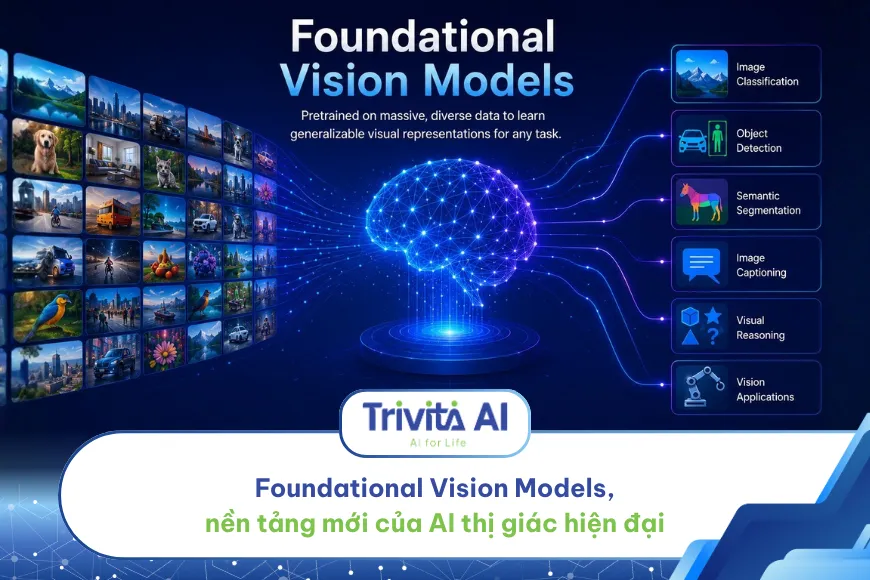
Foundational Vision Models are foundational vision architectures that enable modern AI Vision systems to improve generalization capability, reduce deployment costs and optimize fine-tuning efficiency.
What are Foundational Vision Models?
Foundational Vision Models are Artificial Intelligence models pretrained on extremely large-scale image datasets. Instead of learning only a single task, these models are designed to learn generalized visual representations from diverse image distributions.
Foundational Vision Models can be viewed as a form of “visual knowledge repository,” where the model accumulates large-scale image understanding capabilities before being adapted to downstream tasks. As a result, organizations no longer need to train computer vision models entirely from scratch for each individual application. Instead, they can leverage pretrained models and further fine-tune them according to practical requirements.
This creates a major shift in the development paradigm of modern AI Vision systems. The focus is no longer on building entirely new architectures from the ground up, but on how effectively foundational models can be reused and adapted.
Foundational Vision Models are gradually becoming a core infrastructure layer of modern AI Vision systems.
Why are Foundational Vision Models becoming important?
Strong generalization capability
One of the most significant advantages of Foundational Vision Models is their strong generalization capability. These models can adapt to a wide range of computer vision tasks without requiring complete redesign of the underlying architecture.
From image classification and semantic segmentation to object detection, foundational models can be fine-tuned for many different objectives using only relatively small amounts of additional task-specific data.
This level of generalization makes AI Vision systems significantly more flexible compared to traditional architectures that were often designed specifically for individual tasks.
Reducing AI development time and cost
Previously, developing AI Vision systems often required training models from scratch using massive datasets and substantial computational resources. This created major barriers in both deployment cost and development time.
Foundational Vision Models fundamentally change this workflow. Organizations can reuse pretrained models and perform fine-tuning only for their target tasks.
As a result, AI development becomes faster, more resource-efficient and more practical for enterprise environments.
Increasing real-world deployment capability
Another important advantage of foundational vision architectures is their applicability across multiple real-world domains. These systems are increasingly being used in healthcare, industrial inspection, surveillance, enterprise image analytics and many operational AI applications.
For example, in healthcare, foundational models can be fine-tuned to support pathology image analysis or medical imaging diagnostics. In industrial environments, these models can be adapted for defect detection or production monitoring workflows.
The ability to reuse and flexibly adapt these systems makes Foundational Vision Models highly suitable for large-scale practical AI Vision applications.

Vision Transformer (ViT) and its role in Foundational Vision Models
Vision Transformer (ViT) is currently one of the most widely used backbones in modern Foundational Vision Models.
Unlike traditional CNN architectures, ViT applies Transformer mechanisms to image processing by dividing images into smaller patches and processing them similarly to tokens in language models.
The primary strength of ViT lies in its strong scalability and high performance when trained on large-scale datasets. Because of this, Vision Transformer has become the foundation of many modern computer vision architectures and a critical backbone in current AI Vision research.
The advancement of ViT has also enabled new adaptation approaches such as Visual Prompt Tuning (VPT) and Visual Adaptive Prompt Tuning (VAPT).
Major challenges of Foundational Vision Models
High fine-tuning cost
Despite their advantages, Foundational Vision Models still face major challenges related to fine-tuning cost.
Modern foundational models typically contain extremely large numbers of parameters. Performing full fine-tuning requires updating the entire model, leading to high GPU cost, large memory consumption and extended training time.
This makes large-scale AI Vision deployment difficult for many organizations.
Difficulty in real-world deployment at scale
Not every organization possesses the computational infrastructure necessary to deploy large-scale vision models. For small and medium-sized enterprises in particular, the cost of deploying and maintaining AI Vision systems can become a substantial barrier.
This is one reason why the research community has increasingly shifted toward parameter-efficient adaptation methods that reduce deployment cost while preserving model performance.
Read more:
- Visual Adaptive Prompt Tuning, an advancement toward completing VPT
- Visual Prompt Tuning, a new trend in AI Vision
PEFT, VPT and VAPT are changing how vision models are adapted
What is PEFT (Parameter-Efficient Fine-Tuning)?
PEFT refers to adaptation approaches that allow models to learn new downstream tasks without updating all parameters of the original backbone.
Instead of retraining the full model, PEFT updates only a very small subset of parameters required for adaptation. This significantly reduces computational cost and deployment resource requirements.
PEFT is becoming an important trend in bringing foundational models into enterprise environments.
Visual Prompt Tuning (VPT)
Visual Prompt Tuning is a PEFT method designed for Vision Transformers. Instead of modifying the entire model, VPT inserts learnable prompt tokens into the input token sequence.
The entire pretrained backbone remains frozen, while only the prompts and classification head are updated during training.
This approach substantially reduces the number of trainable parameters compared to full fine-tuning while effectively leveraging the pretrained knowledge already embedded in the foundational model.
Visual Adaptive Prompt Tuning (VAPT)
Visual Adaptive Prompt Tuning represents the next evolution of VPT, aiming to improve model adaptability.
Unlike VPT, which uses static prompts, VAPT generates prompts dynamically based on the input data itself, enabling the model to respond more flexibly to each individual image.
An important characteristic of VAPT is that it still maintains extremely strong parameter efficiency. In many cases, the system updates only around 0.36% of parameters while still outperforming traditional fine-tuning approaches.
This demonstrates how PEFT techniques are opening new opportunities for leveraging large-scale models without requiring prohibitively expensive deployment costs.

Foundational Vision Models are reshaping AI Vision
Foundational Vision Models are reshaping the development paradigm of AI Vision systems. Instead of focusing on training entirely new models from scratch, the AI community is increasingly emphasizing efficient adaptation and reuse of pretrained foundational architectures.
The evolution of Vision Transformer together with techniques such as PEFT, VPT and VAPT indicates that AI Vision is entering a new stage where model performance must coexist with practical deployment capability and resource efficiency.
In the coming years, competitive advantage will not belong solely to organizations that possess larger models, but to those capable of adapting and deploying foundational vision systems more effectively in real-world environments.
