

This article analyzes the enterprise AI agent from an architectural and operational perspective, clarifying how it reasons, makes decisions and executes actions in modern enterprise environments.
How enterprise AI agent systems operate
The presence of the enterprise AI agent is expanding rapidly within organizational technology stacks. From customer support and IT operations coordination to internal workflow automation, the enterprise AI agent increasingly functions as an intelligent intermediary layer between humans and enterprise systems.
Unlike traditional automation software that follows fixed scripts, an enterprise AI agent is designed to interpret context, reason toward defined objectives and execute actions with a degree of autonomy.
Despite growing adoption, many organizations still lack clarity regarding how an enterprise AI agent makes decisions, adjusts behavior and maintains operational consistency over time. Understanding its structure and internal logic is therefore not merely academic. It is a practical requirement for safe, controlled and effective deployment.
What is an enterprise AI agent and how does it differ from traditional software
An enterprise AI agent can be defined as a software entity capable of perceiving its environment through structured and unstructured data inputs, making goal-oriented decisions and executing permitted actions within a defined scope.
The fundamental difference between an enterprise AI agent and conventional software lies in autonomy and adaptability. Traditional systems execute predefined rules. In contrast, an enterprise AI agent can adjust behavior based on new data, evolving context and feedback from prior outcomes.
In current enterprise implementations, these agents remain narrow AI systems optimized for specific tasks such as customer request handling, decision support or workflow orchestration. The concept of general Artificial Intelligence with human-like flexibility remains theoretical and has not materialized in enterprise environments.
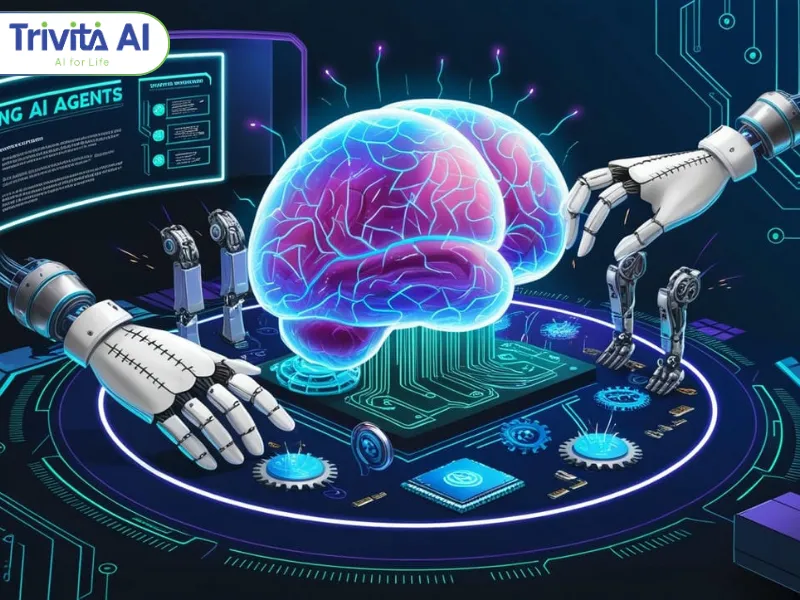
Internal architecture of enterprise AI agent systems
Environmental perception
Every enterprise AI agent requires the ability to ingest and interpret signals from its operational environment. In enterprise contexts, this environment is represented by data streams including emails, service tickets, system logs and data from ERP or CRM platforms.
Accurate perception enables the agent to understand system state, which forms the basis for reasoning and action selection.
Memory and knowledge representation
An enterprise AI agent cannot function effectively without memory structures. These typically include historical data, business knowledge repositories and contextual workflow information.
Memory allows the agent to maintain interaction continuity, reference previous decisions and avoid repeating past errors. Proper memory architecture design directly affects scalability and long-term stability.
Reasoning and planning
At the core of the enterprise AI agent is its reasoning and planning capability. Depending on architecture, reasoning may rely on large language models, rule-based systems or hybrid approaches.
Rather than reacting passively, the agent can evaluate alternative courses of action, anticipate potential consequences and select a sequence aligned with predefined objectives within a specific context.
Action execution and system integration
Enterprise AI agents execute actions by invoking APIs, updating databases, triggering workflows or escalating tasks to human operators when necessary.
Therefore, system integration and access control governance are critical. An enterprise AI agent generates value only when deeply embedded within the enterprise technology ecosystem rather than operating as an isolated tool.
Common architectural patterns
In practice, enterprise AI agent systems may follow different architectural paradigms. Some operate as reactive agents optimized for rapid response to real-time signals. Others emphasize deliberative reasoning and structured planning suited to complex workflows.
Increasingly, hybrid architectures combine reactive responsiveness with structured reasoning layers. This approach allows the enterprise AI agent to remain operationally agile while maintaining sufficient rigor for mission-critical processes.
Learning, adaptation and ethical considerations
How enterprise AI agent systems adapt
Within enterprise environments, the enterprise AI agent is typically refined through performance feedback, newly generated operational data and controlled model updates.
However, adaptation must be carefully governed to prevent drift from original objectives or the emergence of unpredictable behaviors.
Risk and accountability
Enterprise AI agents may reflect or amplify biases embedded in training data. Without oversight, this can lead to unfair decisions, legal exposure or reputational damage.
Accordingly, the enterprise AI agent must operate within a clearly defined governance framework that includes human oversight, traceability of decisions and structured remediation processes.
Strategic implications for organizations
When designed and deployed appropriately, the enterprise AI agent can represent a new operational capability layer. It enables automation of complex processes, scaling of operations without proportional workforce growth and more consistent decision support.
Conversely, without architectural clarity and governance discipline, enterprise AI agents risk becoming opaque black-box systems that introduce systemic vulnerabilities.
The enterprise AI agent is not merely a technological trend. It represents a structural shift in how operational systems are designed.
Understanding how an enterprise AI agent perceives its environment, reasons and executes actions is a prerequisite for responsible, effective and controlled AI deployment in modern organizations.
Source: techaimag.com
