

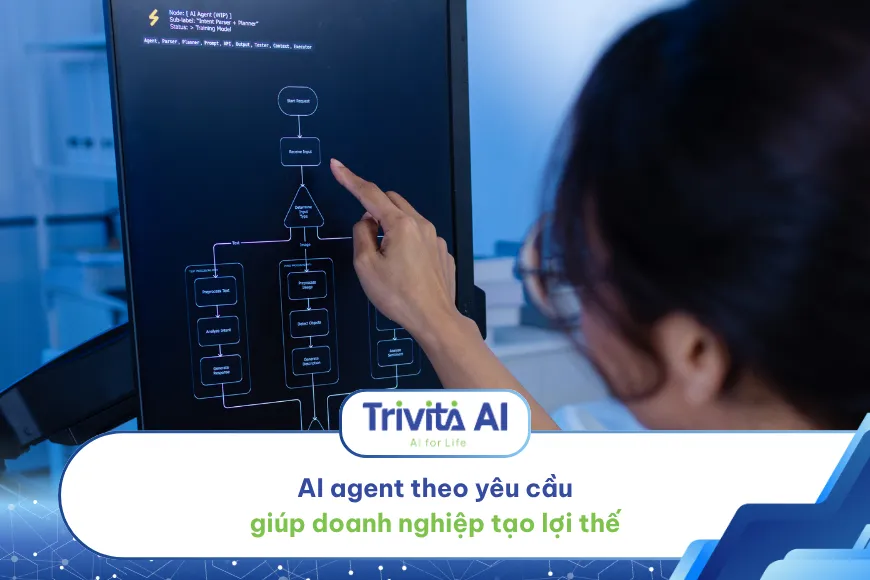
Custom AI agents help businesses automate workflows, connect systems and improve operational efficiency through intelligent models, tools and orchestration layers.
Understanding custom AI agents
A custom AI agent is an artificial intelligence system specifically designed to perform particular tasks within an enterprise based on its operational workflows, data and business objectives. Unlike general-purpose AI tools, custom AI agents do not follow a “one-size-fits-all” approach. Instead, they are developed to align with specific operational contexts.
An AI agent can perform various functions such as customer support, internal process handling, sales assistance, workflow coordination or operational automation. The key distinction is that the system does not merely respond to information requests. It can also reason, plan and execute sequences of actions based on assigned objectives.
In enterprise environments, custom AI agents are becoming a preferred deployment model because every organization has unique workflows, datasets and operating structures. This makes pre-packaged AI solutions insufficient for many real-world business needs.
Why businesses increasingly need custom AI agents
Modern enterprises are not lacking AI tools. The challenge is that most tools only solve isolated tasks, while enterprise operations are built upon interconnected systems of data, people and processes.
As organizations scale, they encounter fragmented workflows, delayed responses, operational dependency on individuals and difficulties maintaining consistency. This is where custom AI agents become valuable, because they can be designed around actual business workflows instead of functioning as standalone utilities.
A properly designed AI agent can understand enterprise context, integrate with internal systems and execute tasks according to organization-specific logic. This enables businesses not only to automate operations but also to standardize and scale operational capabilities over time.

Core components of a custom AI agent system
The model as the reasoning and decision-making core
In a custom AI agent system, the model acts as the central reasoning engine. It enables the agent to understand requests, reason through problems, plan actions and determine the appropriate steps required to achieve objectives.
Modern systems often rely on large language models or multimodal models capable of processing different types of data. However, for enterprise deployment, models must go beyond content generation. They must understand instructions, perform logical reasoning and select suitable tools based on operational context.
In many cases, organizations need to fine-tune models using operational data so the agent can better understand business context, preferred reasoning patterns and internal workflows. This allows AI agents to produce outputs aligned with business operations rather than generic responses.
Tools allow AI agents to interact with the real world
Although AI models can process information effectively, they remain limited without the ability to interact with external systems. This is why tools are a critical component of AI agent architecture.
Tools allow agents to access data, retrieve information from internal systems and execute actions. For example, an AI agent may use tools to retrieve customer transaction histories, update CRM records or send email notifications.
With a tool layer, AI agents evolve beyond information-response systems and become entities capable of performing real operational tasks. This is also a major distinction between AI agents and traditional chatbots.
The orchestration layer determines how the AI agent operates
The orchestration layer governs how AI agents receive information, reason through tasks and decide on subsequent actions. It manages the entire workflow of the agent.
In practice, the complexity of orchestration depends heavily on the nature of the tasks the enterprise expects the AI agent to perform. For simple workflows, orchestration may only determine the next step based on basic conditions. In more complex systems, orchestration must handle multiple states, multiple data sources and sequences of interconnected actions.
The orchestration layer can therefore be viewed as the operational brain of the AI agent, connecting models, tools and workflows into a unified system.
Read more:
- Building AI agents for small businesses
- How AI agents for operations are transforming daily enterprise workflows
How custom AI agents differ from traditional AI chatbots
Many organizations still confuse AI agents with traditional chatbots. In reality, chatbots mainly focus on answering questions or supporting conversations, while AI agents can execute actions and manage workflows.
A chatbot may provide product information, whereas a custom AI agent can receive leads, validate customer data, generate quotations and update CRM systems without requiring manual intervention at each step.
The most significant difference lies in reasoning and action orchestration. AI agents do not simply respond. They understand objectives, plan actions and execute workflows based on real enterprise context.

Practical business value of custom AI agents
When deployed correctly, custom AI agents can significantly reduce repetitive operational workloads. Tasks such as email processing, data entry, customer service and workflow coordination can be automated at a much deeper level than traditional automation systems.
Beyond productivity gains, AI agents help standardize operations and reduce dependency on individual employees. Systems operate according to consistent logic, enabling organizations to maintain operational quality even as they scale.
Custom AI agents also allow businesses to scale more efficiently without proportionally increasing headcount. Once workflows are automated and coordinated effectively, enterprises can process larger workloads without placing additional strain on operational teams.
Challenges in deploying custom AI agents
Despite their advantages, deploying custom AI agents is not straightforward. One of the biggest challenges is that enterprise data is often fragmented and insufficiently standardized. Poor data quality makes it difficult for agents to reason accurately and increases the likelihood of workflow errors.
In addition, AI agents typically need to integrate with internal systems such as CRM, ERP and operational software platforms. This requires organizations to establish sufficiently stable technical infrastructure and system architecture.
Another major challenge involves controlling agent behavior. Once AI systems gain the ability to access systems and execute automated actions, businesses must establish monitoring, validation and risk governance mechanisms to prevent errors from propagating across operations.
Which businesses should deploy custom AI agents early?
Organizations with repetitive workflows, large volumes of customer interactions or complex operational processes are likely to benefit significantly from custom AI agents.
Fast-growing companies in particular often face operational scaling pressure without wanting to expand organizational structures too rapidly. In such cases, AI agents increase processing capacity without requiring proportional workforce expansion.
Industries such as retail, services, education, finance and real estate also represent strong application opportunities because their operations rely heavily on continuous workflows and large-scale data handling.
Custom AI agents are becoming a new operational layer for enterprises
The rise of custom AI agents demonstrates how AI is evolving from a support technology into a direct operational participant within enterprises. These are no longer isolated tools for narrow tasks, but systems capable of reasoning, orchestrating and executing work according to real-world business workflows.
The greatest value of AI agents does not lie in generating smarter responses, but in enabling businesses to operate more efficiently, more consistently and with greater scalability.
In the coming years, competitive advantage will not belong simply to organizations with more AI tools, but to those capable of building AI agents aligned with their own processes and operational systems.
