

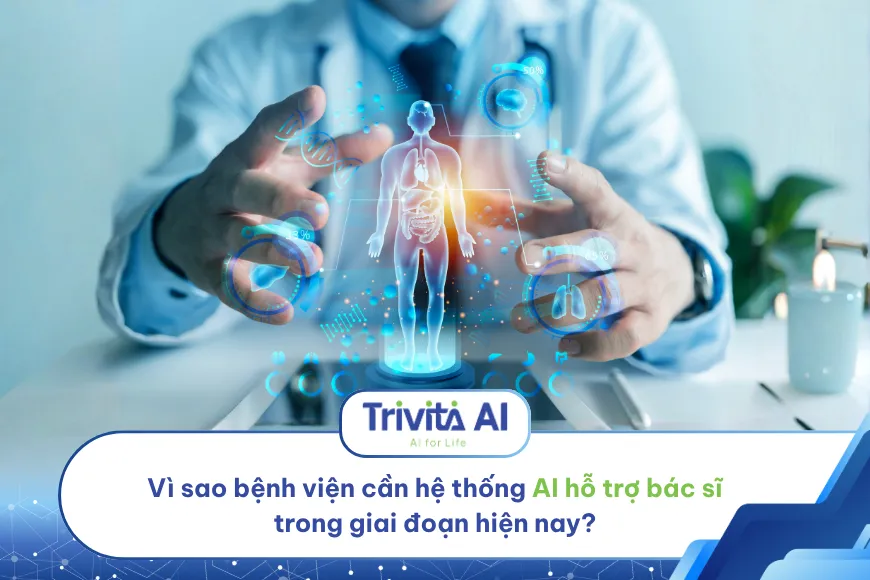
AI systems supporting physicians help hospitals reduce operational pressure, accelerate medical data processing, assist diagnosis and improve patient experience in today’s healthcare environment.
Why is the healthcare industry increasingly in need of AI support for physicians?
The healthcare industry today is facing increasingly severe operational pressure. The number of patients continues to rise rapidly while medical resources in many hospitals remain limited. Physicians are not only responsible for diagnosis and treatment, but also for handling large volumes of data, medical records and administrative procedures.
In many hospitals, physicians’ time is fragmented by repetitive tasks such as consolidating medical records, searching for information or processing paperwork. At the same time, many internal operational systems still rely heavily on manual processes, reducing processing speed and limiting patient experience optimization.
In this context, AI systems supporting physicians are no longer considered experimental technologies or optional additions. AI is gradually becoming a critical support layer that helps healthcare systems operate more efficiently, reduce pressure on medical teams and improve processing capability at larger scales.
What is the role of AI systems supporting physicians?
AI systems supporting physicians are artificial intelligence systems designed to support clinical and operational activities within healthcare environments. These systems can participate in tasks such as medical data analysis, diagnostic support, patient information management or hospital workflow optimization.
Importantly, AI does not replace the physician’s role in treatment. AI acts as a support system that helps reduce workload, accelerate information processing and improve accuracy during decision-making processes.
In modern healthcare environments, AI is increasingly viewed as a tool that allows medical teams to focus more on professional expertise and patient care rather than spending excessive time on manual operational workflows.

Why are AI systems needed to support patients?
Reducing pressure during initial intake
One of the largest operational bottlenecks in hospitals lies in patient intake and initial information processing. AI chatbots and automated support systems can help guide patients, collect preliminary symptoms and assist in triaging care needs before patients meet physicians.
This helps reduce pressure on intake staff and shortens processing time during peak periods.
Increasing response speed and patient support
AI can support tasks such as appointment scheduling, follow-up reminders or answering basic questions related to healthcare services. These tasks consume significant operational time but typically do not require deep medical expertise.
When automated using AI, hospitals can improve response speed and maintain continuous patient support without increasing pressure on operational teams.
Improving patient experience
One of the factors that most strongly impacts patient experience is waiting time and access to information. AI helps patients access healthcare services more easily through 24/7 support and reduced manual processing steps.
When workflows are optimized, patients can access information faster, schedule appointments more conveniently and reduce waiting time throughout the treatment process.
AI not only helps optimize hospital operations, but also helps patients access healthcare services in faster and more convenient ways.
Read more:
- AI in hospitals supports clinical care and healthcare operations
- Risks and ethical challenges when deploying AI in healthcare
Why do physicians need AI support in clinical practice?
Supporting medical data analysis
Today’s physicians must process enormous volumes of data ranging from medical records and laboratory results to medical imaging. Manually consolidating and analyzing all of this information is not only time-consuming, but also increases the risk of errors when data volume becomes too large.
AI supports physicians by analyzing data more rapidly and helping identify important signals within medical records. This enables physicians to access critical information more quickly during patient evaluation.
Supporting anomaly detection and early warning
AI systems can identify patterns and abnormal signals that humans may overlook when processing large-scale datasets. In healthcare environments, this capability is particularly important for screening and risk detection.
AI systems can support early detection of risk indicators based on laboratory data, imaging or patient history, helping physicians gain additional evidence when assessing patient conditions.
Reducing repetitive workload
Many physician activities today are repetitive, including summarizing medical records, writing reports or searching for medical information. These tasks consume substantial time without directly contributing high clinical value.
AI helps automate portions of these activities, reducing workload for physicians and allowing them to dedicate more time to patients and clinically important decisions.
Supporting more accurate decision making
AI can process and analyze data much faster than humans at large scale. This reduces the risk of overlooking important information during evaluation and provides physicians with additional data-driven perspectives before making final decisions.
However, AI does not replace physicians’ professional judgment. The greatest value of AI lies in helping physicians access more complete information and make decisions with greater confidence and reliability.
AI enables physicians to focus more on clinical expertise and patient care instead of being overwhelmed by data volume and administrative workflows.

The role of AI in hospital operations and administration
Automating administrative workflows
Processes such as patient intake, appointment management or record processing still consume significant operational resources in hospitals. AI helps automate these repetitive workflows to reduce manual workload for administrative teams.
When workflows become more efficient, processing speed and patient service capability improve significantly.
Optimizing resource coordination
Hospitals operate under extremely high coordination pressure involving physician schedules, clinics and hospital beds. AI can support operational data analysis to help hospitals utilize resources more effectively.
This becomes especially important during overload periods when effective coordination can directly impact service quality and patient experience.
Supporting hospital data management
AI helps synchronize and retrieve data more efficiently across hospital systems. When data connectivity improves, healthcare teams can access patient information faster and reduce processing time across many internal workflows.
Reducing internal operational pressure
A hospital is not only a treatment environment, but also a highly complex operational system. AI helps reduce manual workload, improve processing efficiency and support more stable long-term operations.
Major benefits of deploying AI systems supporting physicians and hospitals
When implemented correctly, AI systems supporting physicians create substantial value for both healthcare teams and patients. AI improves healthcare efficiency by reducing information processing time and helping physicians access data more quickly.
At the same time, AI reduces operational pressure in hospitals, optimizes administrative workflows and improves patient experience through faster response capability and more convenient processes.
From a clinical perspective, AI supports physicians in data analysis, reduces the risk of overlooked information and improves data-driven decision-making capability.
Challenges of deploying AI in healthcare
Healthcare data security
Patient data belongs to one of the most sensitive categories of information. When deploying AI, hospitals must ensure access control, information security and compliance with healthcare data regulations.
AI accuracy and validation
AI in healthcare cannot be deployed through uncontrolled experimentation. Systems must be continuously validated, monitored and evaluated to ensure reliability before being used in real clinical environments.
System integration capability
Another major challenge is integrating AI with existing systems such as HIS, PACS or electronic medical records. Without strong interoperability, AI systems struggle to deliver effectiveness at hospital-wide scale.
AI supporting physicians help healthcare systems operate more efficiently
AI is gradually becoming an important component of modern healthcare systems. The greatest value of AI systems supporting physicians does not lie in replacing humans, but in reducing workload, accelerating processing and supporting clinical expertise in environments under intense operational pressure.
Physicians remain at the center of treatment and patient care. AI only acts as a support layer that provides healthcare teams with more data, more tools and greater processing capability throughout their work.
The future of healthcare is not “AI replacing physicians.” The future is physicians supported by AI to deliver better, more accurate and more efficient patient care.
