

AI agents for operations help enterprises automate workflows, accelerate processing and optimize costs, becoming a new operational layer in modern organizations.
What AI agents for operations are and how they differ from traditional automation
Before the emergence of AI agents, many enterprises had already adopted automation tools to optimize processes. However, traditional automation operates based on fixed rules and can only handle predefined scenarios.
By contrast, AI agents for operations introduce a fundamentally different approach. Instead of following static rules, AI agents can understand context, evaluate situations and make decisions accordingly. This allows systems to handle more dynamic scenarios without being constrained by rigid workflows.
In addition, AI agents can connect to multiple systems and execute a sequence of actions across them. From receiving a request, verifying information, processing data to updating results, all steps can be handled within a unified workflow.
The core distinction is that AI agents do not simply automate individual steps. They can participate in entire processes. In many operational tasks, this enables AI not only to assist but also to partially replace human execution where appropriate.
How AI agents for operations work in enterprises
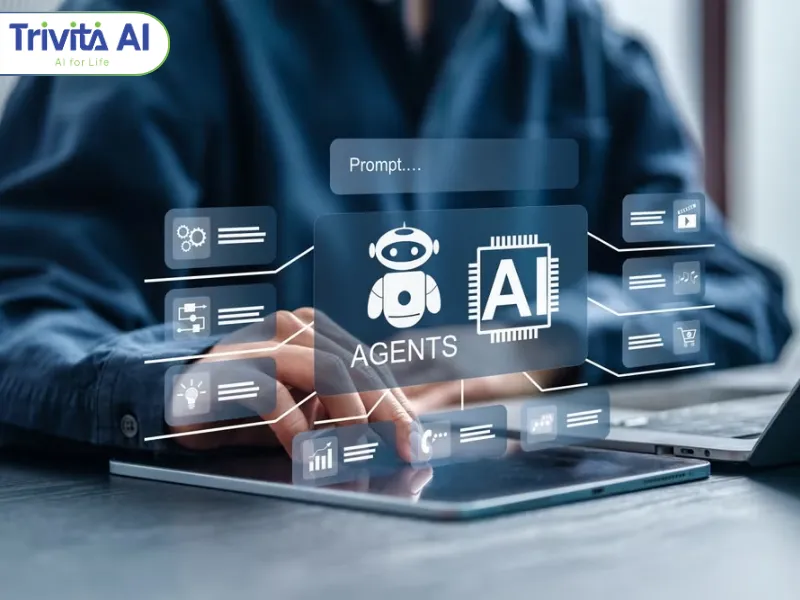
To understand how AI agents for operations function, they can be viewed as a central system responsible for coordinating and executing tasks across the enterprise.
The process begins when the system receives input, which may come from internal systems or customer requests. The AI agent then analyzes the information, understands the context and determines the current state of the workflow.
Based on this analysis, the system decides the next action. These actions may include calling APIs to interact with other systems, processing data or triggering workflow steps that have been predefined.
After execution, the AI agent returns results, updates the system state and ensures the workflow continues smoothly. This continuous loop enables enterprises to process work automatically and consistently.
At its core, this model positions the AI agent as both coordinator and executor. This is the foundation of operational AI systems, where AI becomes an integral part of daily enterprise activities rather than a supporting tool.
5 ways AI agents support enterprise operations
When deployed at high-impact points, AI agents for operations do more than replace isolated tasks. They reshape how enterprises handle daily workflows.
Automating repetitive tasks
A large portion of enterprise work consists of repetitive activities such as handling customer requests, data entry, sending emails or generating reports. These tasks consume significant time while creating limited value.
AI agents can process these tasks automatically based on predefined logic. This allows human resources to focus on strategic and creative activities, improving overall efficiency.
Coordinating work across departments
One of the major operational bottlenecks is the lack of coordination between departments. Information delays, manual communication and dependency on individuals often slow down execution.
AI agents act as a central coordination layer, connecting functions such as sales, marketing and operations. Based on data and workflow status, the system can automatically assign tasks, send reminders and ensure processes are executed in the correct sequence.
This reduces delays and improves cross-functional alignment.
Accelerating processing and response time
In competitive environments, speed is critical. AI agents can handle multiple requests simultaneously and operate continuously without time constraints.
This enables near real-time processing, from customer responses to internal data handling. Faster execution improves both operational performance and customer experience.
Standardizing operational workflows
Variations in how individuals perform tasks often lead to inconsistencies and errors. Without standardized processes, maintaining quality becomes difficult as the organization scales.
AI agents enforce standardized execution by following predefined logic. Every task is handled consistently, reducing errors and ensuring uniform quality across the system.
This is a key foundation for building scalable and stable operations.
Supporting operational decision-making
Beyond execution, AI agents can support decision-making based on data and real-time context. Instead of strictly following rules, they can analyze information and suggest appropriate actions.
This is particularly valuable in scenarios requiring rapid response or when data volume exceeds human processing capacity. While AI does not fully replace human judgment, it enhances decision accuracy and speed.
Which processes should be prioritized for AI agent deployment
Not all processes are suitable for immediate AI agent implementation. To achieve high impact, enterprises should prioritize areas with characteristics aligned with automation and clear value potential.
Customer service processes are a primary candidate. These involve high interaction frequency, require fast responses and include many repetitive tasks.
Sales and marketing operations also benefit significantly, from data processing to customer engagement.
Internally, management and recruitment processes can be optimized, especially in standardized and information-heavy stages.
The key selection criteria include repetition frequency, data clarity and the ability to standardize workflows. Processes that meet these conditions typically deliver fast and measurable results when AI agents are deployed.
AI agents as a new operational layer in enterprises
The emergence of AI agents for operations is creating a fundamental shift in how enterprises organize and execute work. AI is no longer just a supporting tool. It is becoming a core component of operational systems.
In this context, competitive advantage no longer comes solely from products or marketing strategies. It increasingly depends on operational efficiency.
Enterprises that successfully deploy AI agents, integrate them into workflows and maintain stable operations will create a clear performance gap in the market.
This is not just a technology trend. It represents a transformation in how organizations operate, where AI becomes an essential part of daily value creation.
