


An analysis of the artificial intelligence system across three levels, from basic AI agents to production architecture, including planning, memory, orchestration and safety mechanisms.
Artificial intelligence systems are reshaping operations
AI development no longer centers solely on language models that respond to isolated prompts. A modern artificial intelligence system can decompose objectives, use tools, make decisions and iterate actions until a task is completed.
If a chatbot answers individual questions, an AI agent pursues a goal. The distinction lies in autonomy.
However, building such a system is significantly more complex than deploying a conversational model. Without careful design, an agent may enter infinite loops, select incorrect tools or generate outputs that appear plausible but are factually incorrect.
To understand the structure clearly, it is useful to approach the artificial intelligence system across three levels: foundational capability, real-world system design and production-scale operation.
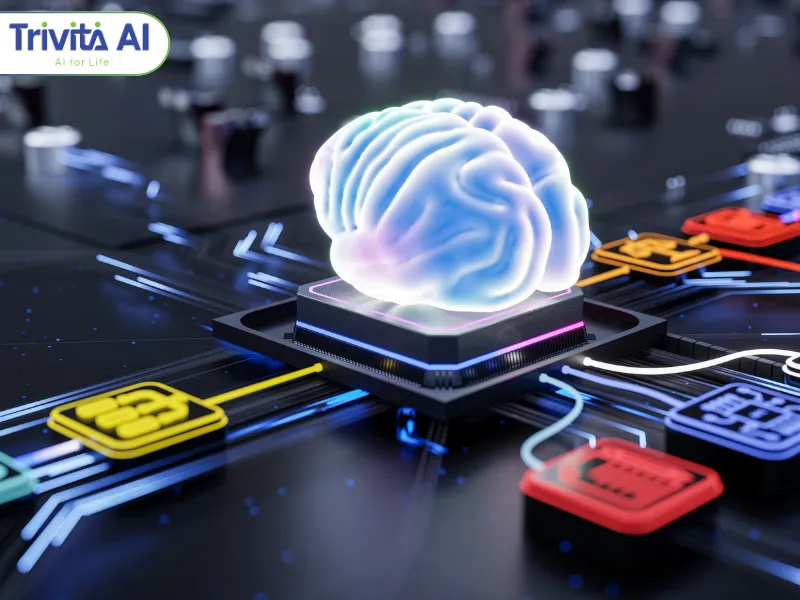
Level 1: From chatbot to autonomous system
At the foundational level, an agent-based artificial intelligence system consists of three core components: tool usage, planning and memory.
Tool usage enables the agent to access APIs, databases or enterprise systems rather than generating standalone text. This grounds the system in real operational data.
Planning allows the agent to break down high-level objectives into executable steps. For example, a market analysis request may require data collection, trend comparison and synthesis of conclusions.
Memory enables the agent to maintain state across execution. It tracks attempted strategies, failed attempts and remaining steps.
The basic agent loop follows a recurring pattern: observe system state, decide the next action, execute and evaluate outcomes. This loop continues until termination conditions are met.
Level 2: Designing and building real-world systems
When deployed in practical environments, an artificial intelligence system requires a clearly defined architecture.
One common architecture is ReAct, where reasoning and action are interleaved. This structure improves transparency and debugging capability.
The Plan-and-Execute model separates planning from execution. The agent constructs a comprehensive plan before acting, reducing the risk of localized repetitive loops.
Reflection mechanisms allow the system to adjust strategies within the same session when errors occur.
Tool design is equally critical. Tools must expose well-defined schemas, structured JSON outputs and explicit error handling. Without these safeguards, the agent may misinterpret responses or execute incorrect commands.
State management should be separated from conversational history. A structured state object allows the system to track progress and enforce termination conditions. These conditions typically include loop limits, resource constraints and repetition detection mechanisms.
Evaluation metrics must extend beyond task completion rates. Action efficiency and error categorization are necessary to improve stability and robustness.
Level 3: Artificial intelligence systems in production environments
At production scale, the artificial intelligence system requires orchestration, monitoring and risk control.
Advanced planning may incorporate hierarchical task decomposition. A coordinating agent distributes subtasks to specialized agents, enabling parallelization and functional specialization.
Tool management at scale requires asynchronous execution, caching strategies and rate limiting to control API usage and operational cost.
Advanced memory architectures may use vector databases for semantic retrieval or knowledge graphs to support relational reasoning. However, memory consolidation and compression mechanisms are essential to prevent uncontrolled growth.
Safety mechanisms are mandatory. Guardrails define permissible and restricted actions. Sandboxing isolates execution environments. Audit logs record all actions. Kill switches allow immediate shutdown when abnormal behavior is detected.
Observability is central in production environments. The system must capture full reasoning traces and decision paths for post-hoc analysis. Real-time monitoring enables early detection of anomalies and performance degradation.
In complex deployments, multi-agent coordination requires clearly defined communication protocols. The coordinating agent aggregates outputs from specialized agents to produce unified results.
Cost optimization strategies may include model routing, using smaller models for routine tasks and escalating to larger models only for complex reasoning scenarios.

Building artificial intelligence systems as infrastructure
An artificial intelligence system should not be viewed as an enhanced chatbot. It is a distributed software system with structured state management, orchestration, fault tolerance and observability comparable to large-scale enterprise software platforms.
Organizations deploying AI agents must adopt an infrastructure mindset rather than relying on isolated prompt experimentation. This demands architectural clarity, governance processes and continuous evaluation.
An artificial intelligence system represents a shift from response-based models to goal-executing systems. However, stable large-scale deployment requires full software-system discipline, including architecture design, state control, orchestration, memory management, monitoring and safety enforcement.
Enterprises that understand these structural requirements and limitations will avoid unrealistic expectations and build sustainable AI foundations capable of scaling while maintaining long-term risk control.
Source: kdnuggets.com
