

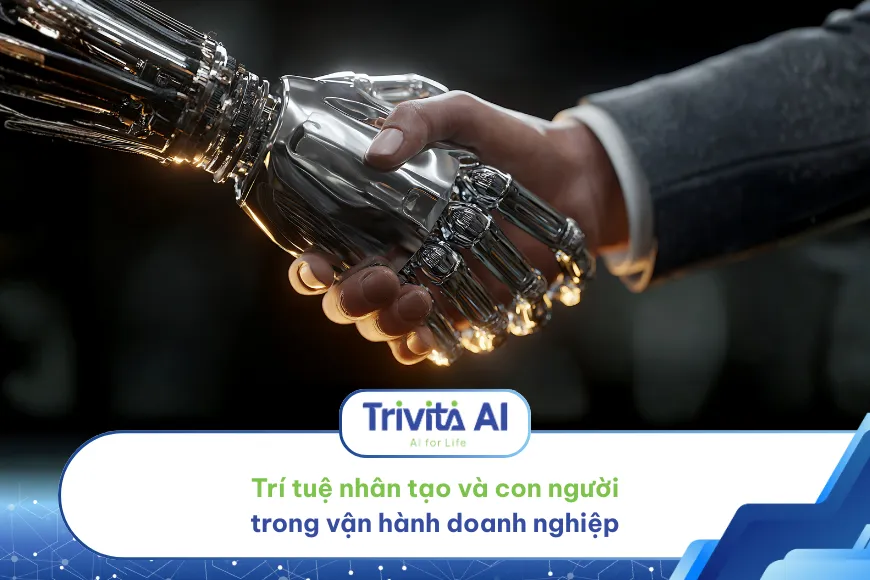
An analysis of when artificial intelligence and humans should collaborate and when they should operate independently to achieve practical efficiency in enterprises.
Why enterprises must reassess the relationship between artificial intelligence and humans
In recent years, the collaboration between artificial intelligence and humans has been widely viewed as an obvious principle for improving performance. The prevailing assumption suggests that AI complements human limitations in speed, data processing capacity and consistency, thereby producing superior outcomes compared to relying on either side alone.
However, real-world enterprise implementation demonstrates that this assumption does not always hold. Many AI initiatives fail not because the technology is inadequate, but because organizations have not clearly determined when artificial intelligence and humans should work together and when each should operate independently. Reassessing this relationship has become essential for enterprises aiming to deploy AI effectively and sustainably.
What research reveals about combining artificial intelligence and humans
Combination does not automatically produce superior results
A large-scale study conducted by the MIT Center for Collective Intelligence found that, on average, systems combining artificial intelligence and humans did not outperform systems relying solely on AI or solely on humans. This finding challenges the widespread belief that hybrid systems are inherently superior.
The research synthesized more than 100 scientific studies and analyzed 370 performance metrics across 106 experiments. Results indicated that the average performance of hybrid systems was often lower than the best-performing standalone system in each specific context, whether AI-driven or human-driven.
When human limitations weaken hybrid performance
In tasks where humans lack comparative strength, combining artificial intelligence and humans may reduce performance rather than improve it. One key reason is that humans are often inconsistent in determining when to trust AI outputs and when to intervene, leading to suboptimal decision-making.
Conversely, in tasks where humans possess clear advantages, especially those requiring domain expertise and deep contextual understanding, collaboration between artificial intelligence and humans can produce significantly stronger outcomes.
Where should artificial intelligence and humans operate within enterprise processes?
Areas where AI should operate independently
Within enterprise operations, AI demonstrates clear advantages in repetitive, high-volume and data-intensive tasks. In such contexts, consistency, speed and scalability are more critical than subjective judgment.
Activities such as large-scale data analysis, document processing, anomaly detection, demand forecasting and scheduling optimization are examples where independent AI operation often outperforms loosely defined hybrid models.
Areas where humans must remain central
Humans remain indispensable in stages that require contextual reasoning, risk evaluation, strategic judgment and handling of social or emotional factors. These represent critical control points in enterprise workflows where AI, despite computational strength, remains limited.
Clearly defining this boundary prevents both the underutilization of AI and the unnecessary cognitive burden placed on human operators.
When do artificial intelligence and humans collaborate most effectively?
Collaborative strength in creative tasks
Research indicates that the collaboration between artificial intelligence and humans is most effective in creative tasks, particularly with the rise of generative AI systems. Unlike traditional AI models focused primarily on deterministic decision-making, generative AI enables iterative human-AI interaction loops.
In this model, humans provide direction, evaluation and selection, while AI generates suggestions, expands possibilities and accelerates ideation. This collaborative dynamic enables individuals to explore more options within shorter timeframes, ultimately enhancing output quality.
Limitations in purely data-driven decision tasks
In purely data-driven decision environments, mandating human involvement at every stage can reduce overall efficiency. In such cases, independent AI operation supported by appropriate oversight mechanisms often delivers superior results compared to ambiguous hybrid models.
How enterprises should design the relationship between artificial intelligence and humans
Redesign workflows instead of attaching AI to legacy processes
A common mistake is treating AI as an additional technology layer that can simply be attached to existing workflows. This approach overlooks a more fundamental question: how should processes be redesigned to leverage the strengths of both artificial intelligence and humans?
True synergy does not arise from dividing tasks superficially between AI and people. It requires restructuring the entire workflow architecture to optimize end-to-end value creation.
Defining clear roles to generate long-term value
Artificial intelligence and humans generate sustainable value only when each operates within clearly defined roles. AI should be granted autonomy in areas where it demonstrates measurable superiority, while humans should focus on high-impact strategic decisions that carry accountability and ethical responsibility.
Enterprises that define this boundary effectively will not only improve short-term operational efficiency but also build a durable foundation for long-term AI-driven value creation.
Sustainable value from artificial intelligence and humans emerges only when enterprises understand the intrinsic nature of different task types and design workflows accordingly. AI does not always require human collaboration, and humans should not intervene in processes where AI demonstrably performs better.
Organizations that establish this boundary with precision will avoid unrealistic expectations about AI and unlock long-term value in a structured and controlled manner.
Source: mitsloan.mit.edu
