

Artificial intelligence is fundamentally transforming the way people work and acquire knowledge. In the workplace, AI replaces repetitive tasks, analyzes data to support decision-making, and creates new types of occupations. In education, AI enables personalized learning, provides virtual teaching assistants, and supports simulated practice, delivering more flexible and effective learning experiences.
Artificial intelligence is transforming the workplace
Automation of repetitive tasks
Artificial intelligence has the capacity to replace humans in repetitive tasks that are time-consuming yet offer limited creative value. AI systems can perform accurate data entry, process and classify emails, support customer service through chatbots, and optimize inventory management processes by integrating IoT sensors with data analytics.
As a result, enterprises can reduce the volume of manual work, minimize errors, and achieve significant operational cost savings. More importantly, employees gain additional time to focus on tasks that require strategic thinking, creativity, and high value creation, rather than being constrained by repetitive daily activities.
Supporting faster and more accurate decision-making
In today’s business environment, the speed and accuracy of managerial decision-making can determine competitive advantage. Artificial intelligence analyzes large-scale data from multiple sources, including customer behavior, market trends, financial reports, and social media feedback. Based on these analyses, AI provides strategic recommendations that enable managers to identify opportunities, anticipate risks, and optimize operational processes.
For example, in retail, AI can forecast seasonal demand to help enterprises prepare appropriate inventory levels; in finance, AI detects anomalous signals to mitigate investment risks. The ability to rapidly process massive volumes of data enables humans to make more accurate decisions, rather than relying solely on experience or intuition.
Creating new occupations
The rapid expansion of artificial intelligence not only replaces certain traditional jobs but also gives rise to entirely new professions. Roles such as AI engineers, data scientists, machine learning engineers, big data analysts, and AI ethics specialists are increasingly in high demand in the labor market.
In addition, the advancement of AI has generated demand for related roles such as automated systems management, AI-integrated product design, and digital transformation consulting for enterprises. This indicates that rather than fearing job displacement, workers can leverage opportunities to acquire new skills and participate in rapidly growing, high-income fields.
Transforming the required workforce skill sets
The increasingly prominent presence of artificial intelligence is significantly reshaping the skill requirements of the workforce. Rather than focusing on repetitive tasks, employees need to develop capabilities such as creativity, critical thinking, and complex problem-solving—areas that are difficult for machines to replace. In addition, data literacy, technological understanding, and the ability to collaborate effectively with AI systems are becoming new sources of competitive advantage.
Workers also need to cultivate soft skills such as communication, team management, and adaptability to rapid change in order to complement roles that require close collaboration between humans and technology. This transition compels individuals to engage in continuous learning and regularly update their knowledge if they wish to remain competitive in an increasingly dynamic labor market.
Artificial intelligence is transforming the way people learn
Personalized learning enabled by artificial intelligence
One of the most notable innovations that artificial intelligence brings to education is the ability to personalize learning experiences. By analyzing data on academic performance, learning pace, and levels of engagement across subjects, AI can design individualized learning pathways tailored to each learner’s abilities and goals.
For example, if a student struggles with mathematics but performs well in foreign languages, an AI system can automatically recommend additional mathematics exercises at an appropriate level while simultaneously increasing the difficulty of language content. This approach helps learners avoid overload or disengagement while maximizing individual potential. Through personalized learning, education becomes more flexible, effective, and learner-centered, rather than applying a rigid, one-size-fits-all curriculum.
Virtual teaching assistants and educational chatbots
Artificial intelligence has enabled the development of “virtual teaching assistants” and intelligent chatbot systems capable of providing learning support 24/7. These tools can answer questions, explain complex concepts, recommend reference materials, and even assess assignments in real time. With natural language processing capabilities, educational chatbots interact directly with learners, ensuring continuity in the learning process even in the absence of instructors.
In particular, virtual teaching assistants can track learning progress, provide personalized recommendations, and deliver regular study reminders, thereby enhancing learners’ autonomy and self-discipline. The adoption of virtual teaching assistants and chatbots not only reduces teachers’ workload but also expands access to knowledge for students in regions with limited access to traditional educational resources.
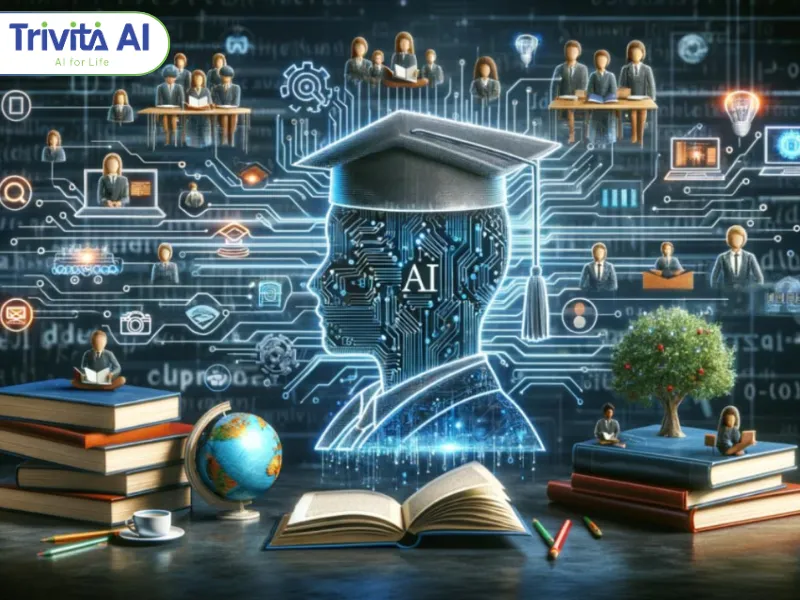
Learning analytics
By leveraging large-scale data processing capabilities, artificial intelligence enables education to shift from traditional assessment methods to a data-driven approach. AI systems can collect and analyze information from learners’ study processes, including grades, time spent completing assignments, levels of class participation, and feedback generated through interactions.
As a result, AI can accurately identify individual strengths and weaknesses, predict the risk of falling behind, and recommend timely interventions. Teachers thus gain additional tools to monitor progress and provide targeted support at the right time and in the right areas. For students, receiving rapid and personalized feedback enables them to adjust learning strategies more effectively, thereby enhancing knowledge acquisition.
Simulation and virtual practice
The integration of artificial intelligence with virtual and augmented reality technologies (VR/AR) is opening up entirely new approaches to learning. AI can generate highly realistic simulated environments, enabling learners to practice complex scenarios without being constrained by physical space or real-world risks.
For example, medical students can participate in simulated surgical procedures to refine their skills, while engineering students can operate virtual production lines designed to closely mirror real-world systems. AI also monitors practice sessions, evaluates performance accuracy, and provides immediate feedback and improvement recommendations.
As a result, learners not only acquire theoretical knowledge but also develop professional skills in a safe, cost-effective environment that allows repeated practice to achieve optimal outcomes. Artificial intelligence is reshaping the standards of work and learning in the digital era. Proactively understanding and leveraging AI is how individuals prepare for a sustainable future.
